Did you know?
Ion Beam Analysis
This is the inaugural edition of a new column, "Did you know?", which seeks to educate our user community on underutilitized -- or even unknown -- capabilities in the CharFac. While aware of "base instruments" such as SEM, TEM, AFM, XRD and perhaps a few others, many potential users are oblivious to methods such as IBA (RBS/FReS/PIXE/PIGE), AFM-IR, STM/STS, microcontact angle and a few others; or special attachments/options on well-known instruments. Part of our role, as scientists working to elevate analytical research at the University of Minnesota, is to communicate, and even champion, such capabilities; and by spurring greater usage, better cover the costs of maintaining such systems.
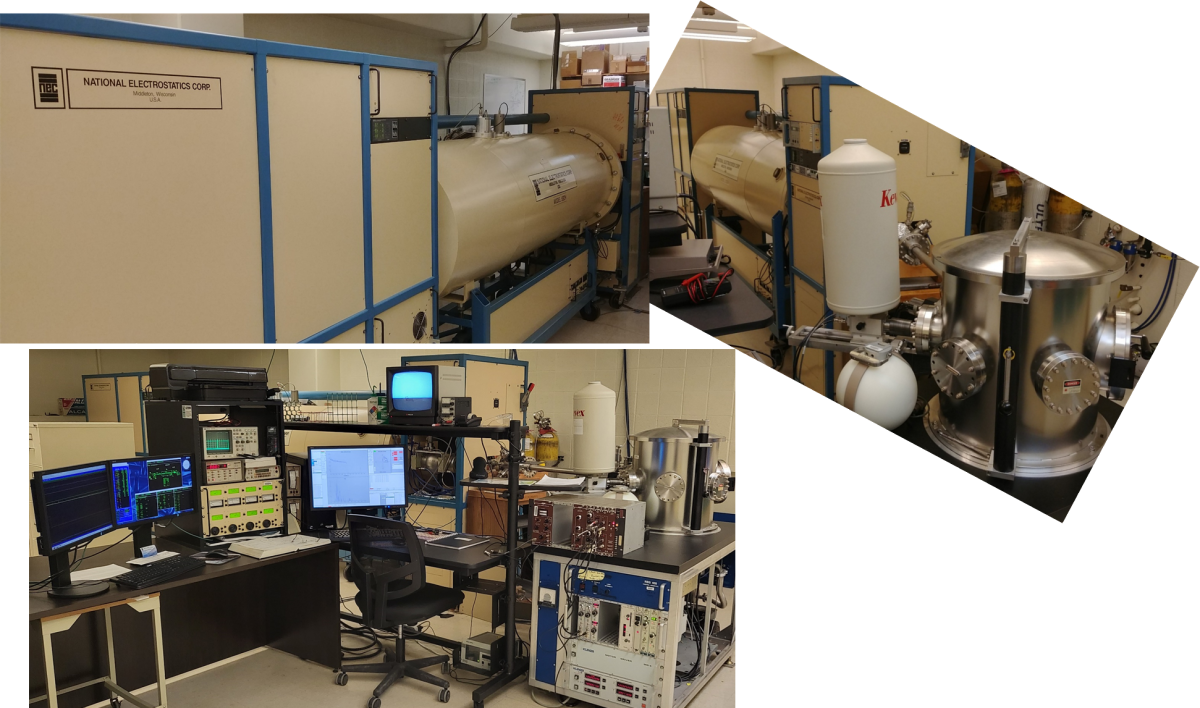
In this issue we feature ion beam analysis, which includes particle-accelerator methods based upon nuclear scattering. In Shepherd Labs room 202 we operate a He ion beam within an energy range of roughly 1.5-5 MeV (yes, millions of electron volts). The most commonly utilized method is Rutherford backscattering, where we count the backscattered (ejected) He++ nuclei due to billiard-ball collisions with nuclei inside a sample of interest. Most He++ is deposited deep into the sample (at very low concentration), while a small fraction backscatters to enable the analysis of elemental composition and its depth dependence (down to ~10 nm depth resolution). A sister technique is FReS: forward recoil spectrometry, which analyzes ejected protons and deuterons from a sample if contained therein (down to ca. 0.1% H composition). In both cases the depth sensitivity arises in part from energy lost to excited electrons in a sample, which moreover generates characteristic X-ray emission (but at higher s/n than in EDS, as performed in an SEM or TEM).
Additionally, He++ incident on light nuclei can cause nuclear reactions that may generate characteristic gamma-ray emission. More commonly one analyzes the ejected He++ as in RBS, but nuclear reactions can enhance the scattering cross section. Thus the normally poor signal for scattering from light elements such as C (e.g., in self-assembled monolayers, as Prof. Dan Frisbie's group has utilized in multiple thesis projects) or O (e.g., in oxide thin films) can be enhanced by one or two orders of magnifude. The beam energies needed for such reactions are commonly >3 MeV, which cannot be reached by accelerators at some universities. In our lab we routinely exploit these reactions. In all of the above cases the techniques are nondestructive (i.e., non-sputtering); in the case of RBS and FReS they are also absolutely quantitative (not needing standards). Finally, for single-crystal or epitaxial materials, He++ channeling can be used to analyze departures from perfect crystallinity, such as the fraction of (heavy) dopant atoms located at interstitial sites instead of lattice sites. For more information see the CharFac IBA web page (cse.umn.edu/charfac/ion-beam-analysis) and references therein.