Solar Sailing: Harnessing the Sun for Space Propulsion Using Cable-Driven Robots
Solar sails could change the future of spaceflight by their ability to generate propulsion through reflection of the Sun’s photons, allowing them to perform unique and impactful space missions without the need to carry fuel. For example, a solar sail could be placed between the Earth and the Sun and provide an early warning that would allow us to prepare in the event of solar flares that could disrupt our power grids and critical communication infrastructure. An array of solar sails could be placed in a similar fashion to create a solar shade system that cools the Earth and slows down climate change. In the distant future, solar sails could even be used to reach other galaxies. None of these missions are possible with current fuel-based space propulsion, as relying on fuel places strict limits on the operational lifetime of a spacecraft. Solar sails need to be very large (e.g., larger than a football field) and lightweight (e.g., lighter than a refrigerator) for them to generate sufficient propulsion. This causes them to be quite flexible (i.e., susceptible to large amplitude vibrations and unwanted deflections) and makes it extremely difficult to reliably control the solar sail’s orientation, and thus, its direction of propulsion. This is an unsolved problem that is preventing solar sails from becoming a reality.
The Aerospace, Robotics, Dynamics, and Control (ARDC) Laboratory, directed by Prof. Ryan Caverly, aims to solve this problem through the development of the Cable-Actuated Bio-inspired Lightweight Elastic Solar Sail (CABLESSail) concept that uses cable-driven robotic technology to control the shape of the solar sail (see Figure 2), much like how a starfish can move its arms to change its shape. Cables are capable of transmitting forces across long distances, making them ideal for use with large solar sails. Using cables to control the shape of the sail allows for the photons of the Sun to be harnessed in such a manner that the sail becomes a controllable vane and can be rotated in any desired direction. We are developing designs of this concept that would be capable of controlling solar sails that are at least 100 times larger than what is possible with current technology. This research effort is sponsored by NASA’s Early Career Faculty program and is performed in conjunction with collaborators at NASA Marshall Space Flight Center, who view CABLESSail as one of the few viable options to consider in the design of the large solar sails that will be launched within the next decade.
Successfully controlling the shape and orientation of a large-scale solar sail driven by cables relies on solving two key challenges: (1) obtaining accurate knowledge of the deflections in its flexible structure and (2) developing practical and reliable methods to control the deflections.
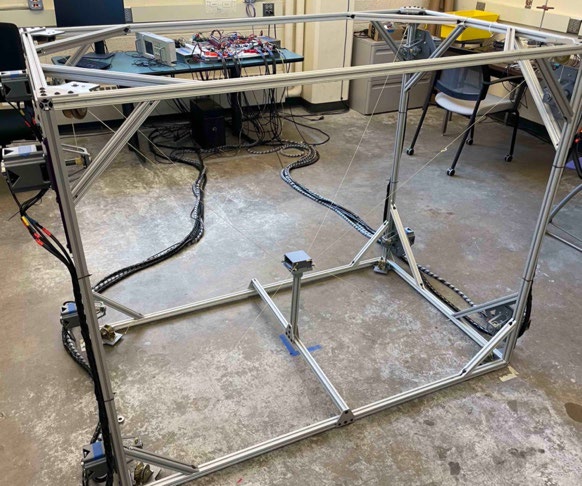
Estimation of a Solar Sail’s Flexible Structure Deflections: Inaccurate knowledge of the solar sail’s deflection can result in situations where the sail’s direction needs to be adjusted, but it is unknown exactly which corrective actions need to be made (e.g., does the structure need to be bent upwards or downwards?). Most research in this area has focused on developing more accurate sensors. Although this approach is valuable, it does not address the fundamental limit on the accuracy of deflection that can be estimated from a single sensor. The ARDC Lab’s research in this area has focused on uniquely combining information from multiple sensors in a manner that achieves greater accuracy than what can be obtained by any individual sensor. We have been developing these methods using state estimation theory, followed by validation in numerical simulation and experiments on cable-driven parallel robots in our research lab (see Figure 3).
Practical and Reliable Control of the Deformations of a Flexible Solar Sail: Solving this challenge involves developing control algorithms that run on-board a computer, take in sensor data (e.g., the deflection of the solar sail structure) and then generate control inputs (e.g., a commanded change in cable tension). What makes control challenging is the fact that a mathematical model of the system under control is never perfectly known. There are many aspects of the solar sail that are difficult to incorporate into a mathematical/physics-based model, including vibrations in the sail, its supporting structure, and cables; non-uniform/uncertain material properties; and unforeseen environmental effects in space. This uncertainty can have devastating effects on the system being controlled, for example, the controller itself amplifying unwanted vibrations rather than damping them. Controllers that are robust to changes in the system being controlled are thus of great importance in an application like a solar sail. Most approaches in the literature either ignore these uncertain aspects of the model, which is risky and unreliable, or attempt to learn all the parameters of the system model during operation, which is time-consuming and oftentimes impractical.
The ARDC Lab has developed control methods for cable-driven systems that carefully distinguish between the uncertain aspects of the model that need to be learned during its operation and those that can be left uncertain without sacrificing reliability. These algorithms are relatively simple to implement on-board a spacecraft’s computer (i.e., they require little on-board memory and computation time) and provide a mathematical certification of performance and stability even without perfect knowledge of the system. The ARDC Lab is currently working on extending these methods to bypass the need for arduous derivations by hand prior to implementation and rather use efficient on-board data collection and optimization procedures to perform the mathematical certification process. This will make for a large leap in the transition from laboratory testing to the practical control of cable-driven solar sails in space.