Minnesota Starwatch
MARCH 2024
In March the iconic winter constellations come out in the south to southwest at nightfall. If you haven’t seen

them yet, grab a star chart and enjoy everything from brilliant Sirius, at the bottom of the array, to aloof and majestic Capella, which caps the assembly. Compare these stars to Jupiter, the beacon to the west. To the east, the spring constellation Leo, the lion, rears up as if preparing to drive the winter stars westward. Watch the waxing moon pass Jupiter on the 13th and the Pleiades star cluster on the 14th. The evening of the 18th, the moon will be close to Pollux, the brighter Gemini twin. On the 16th, we get the highest first quarter moon of the year. This is no random event; at the spring equinox the Northern Hemisphere tilts most strongly toward the position of a first quarter moon. Conversely, on the 3rd a very low last quarter moon will appear in the southern predawn sky close to Antares, the red heart of Scorpius. Both quarter moons make good objects for binocular viewing. Being so low, the last quarter phase will be easier on the neck muscles. However, it rises in the middle of the night and sets—depending on your location—approximately eight hours later, whereas the first quarter moon rises in mid-morning and is up for about twice as long. The moon becomes full at 2 a.m. on March 25. Most of this full moon will pass through Earth’s penumbra—our planet’s light outer shadow. The penumbra will be hard to detect from Earth, but if you were on the moon you’d be watching a partial eclipse of the sun. Spring arrives with the equinox at 10:06 p.m. on March 19. At that moment the sun crosses the equator on its journey north and Earth will be lighted from pole to pole.
JANUARY 2024
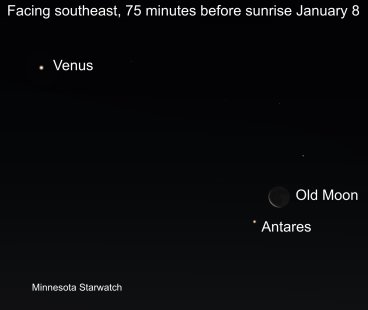
January may be frigid, but the cold air means clearer skies for viewing the jewels scattered among the iconic winter stars. By the 7th, hourglass-shaped Orion, the hunter, and all its companion constellations will be up in the southeast at 8 p.m. The last of the bright winter stars to clear the southeastern horizon is Sirius, in Canis Major, the big dog. Sirius outshines the other stars, but high in the south, brilliant Jupiter dominates the sky. As you gaze at Orion, notice the glowing nebula in his sword. The sword hangs from the three closely spaced stars of his belt, which form the ”waist” of his hourglass shape. Extending a line through the belt stars upward, you’ll see Aldebaran, the eye of Taurus, the bull. The V-shaped face of the bull, formed by stars of the Hyades cluster, is also an eye pleaser. Then look to the upper right of Aldebaran to view the young—astronomically speaking—and beautiful Pleiades star cluster. But as the winter stars climb in the east, Saturn sinks in the west. If you’re unsure which object is the ringed planet, a young crescent moon hangs below it at nightfall on the 13th. In the predawn sky, regal Venus still shines low in the southeast. During the first two weeks of January, watch red Antares, the heart of Scorpius, climb past the planet. On the 8th, don’t miss the spectacle of an old crescent moon threatening to blot out Antares. On the 2nd, Earth reaches perihelion, its closest approach to the sun in an orbit. At that moment we’ll be about 91.4 million miles from our parent star and moving at top speed around it. January’s full moon rises on the 25th and follows the gaggle of winter constellations across the night sky. Following those stars every night is Regulus, the heart of the spring constellation Leo, the lion.