Professor Erin Carlson
Professor Erin Carlson
Department of Chemistry
University of Minnesota
Bacterial Resistance: Threats and Therapeutics
The death toll from antibiotic-resistant (ABR) infection is projected to be 40 million people worldwide between now and 2050, when these infections will cause greater mortality than cancer in the US. Recent data indicates that treatment of only six of the most dangerous resistant bacteria costs more than $4.6 billion in the US annually. Despite this extreme situation, there has been little global investment in the development of new treatments to tackle ABR. Infections from Gram-negative pathogens are exceptionally difficult to treat given the high occurrence of resistance in these organisms. To address this challenge, our approach is to develop treatments that weaken the pathogen’s ability to establish and maintain an infection (anti-virulence) or to resist antibiotic treatment (adjuvant).
We have demonstrated that interruption of the way that bacteria interact with their environment has the potential to reverse and even eradicate ABR. Microbes are amazingly adaptive and can thrive under ever changing conditions while defending against other species and invading hosts. This success stems from their ability to sense and respond to diverse environmental cues, including trace nutrients, antibiotics, and signals from neighboring biota. This seminar will focus on resistance to polymyxin antibiotics, which are used as a last resort treatment. We have discovered a novel mechanism by which bacteria evolve resistance to this critical class of drugs following exposure to metals commonly found in waste sites throughout the world. In addition, we have developed therapeutic leads that interrupt the pathways required for resistant bacteria to sense and respond to the polymyxins, making them again susceptible to this clinically important class of drugs.
Erin Carlson
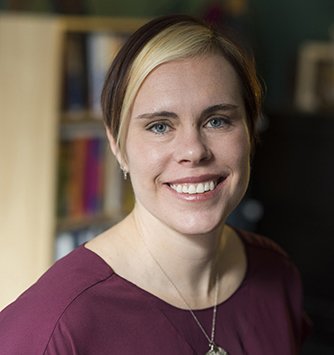
Dr. Erin E. Carlson (she/her) received her B.A. at St. Olaf College (Northfield, MN) in 2000. She went on to graduate studies funded by the NIH Predoctoral Biotechnology Training Program at the University of Wisconsin - Madison and earned a Ph.D. in organic chemistry in 2005 under the direction of Professor Laura L. Kiessling. Subsequently, Dr. Carlson was awarded an American Cancer Society Postdoctoral Fellowship for studies at The Scripps Research Institute with Professor Benjamin F. Cravatt. In 2007, Dr. Carlson received an NIH Pathway to Independence Award (K99/R00) and joined the faculty at Indiana University in 2008. In the summer of 2014, she joined the faculty in the Chemistry Department at the University of Minnesota and is also appointed as a Graduate Faculty member of the Department of Medicinal Chemistry, the Department of Biochemistry, Molecular Biology and Biophysics, Department of Molecular Pharmacology and Therapeutics, and the graduate program in Biomedical Informatics and Computational Biology. In 2021, Dr. Carlson was promoted to the endowed position of Smith Professor of Chemistry and in 2025 she was named a Distinguished McKnight University Professor.
Since the start of her independent career, Professor Carlson has won numerous awards including being named a Presidential Early Career Awards for Scientists and Engineers (PECASE) recipient, a Pew Biomedical Scholar, the NIH Director’s New Innovator Award, American Chemical Society Women Chemists Committee (WCC) Rising Star Award, the Indiana University Outstanding Junior Faculty Award, the NSF CAREER Award, the Cottrell Scholar Award, the Cottrell SEED Award, and was named a Sloan Research Fellow and an Indiana University Dean’s Fellow. Dr. Carlson received the Outstanding Postdoctoral Mentor Award from the University of Minnesota Postdoctoral Association in 2017. Professor Carlson currently serves as the co-director of the Chemical Biology Initiative and is co-Principle Investigator of the NIH-funded Chemistry-Biology Interface Training Grant (T32).
Host: Professor William C.K. Pomerantz
331 Smith Hall
Zoom Link