Structural Testing Facilities
Labs Director: Lauren Linderman
Labs Manager and Research Associate: Steve Barbachyn
Affiliated faculty: Pedram Mortazavi and Ben Worsfold
The Multi-Axial Subassemblage Testing (MAST) Laboratory
The largest test system of its kind in the world. It provides a powerful tool for investigating the effects of earthquakes, hurricanes, and other extreme events on large structural components up to several stories tall.
MAST Laboratory information and capabilities (opens in new tab)
The Theodore V. Galambos Structural Engineering Laboratory
Named for Ted Galambos, the father of Load and Resistance Factor Design (LRFD), this lab is a four-story space designed for modeling and testing large-scale structural components. It features a 12x24m (40 x 80 ft) strong floor with a 12m (40 ft) high-bay reaction wall.
Testing systems include an MTS Universal Material Test Frame with hydraulic wedge grips, an earthquake simulator, and a Forney Concrete Test Machine. A series of eleven high-capacity MTS fatigue-rated hydraulic actuators and reconfigurable load frames can be set up to investigate a variety of test cases.
Three environmental chambers include one that controls temperatures to study weather effects ranging from sub-freezing to 60oC (140oF) to accelerate the study of creep and shrinkage effects. Another chamber features humidity control in addition to temperature.
A variety of instrumentation and data acquisition equipment is available. Including load cells, LVDTs, string pots, vibrating wire strain gauges, and temperature sensors. The data acquisition equipment includes a Pacific Instruments Series 6000 system with 208 channels of high-speed data acquisition for voltage or strain gauge sensors as well as 32 channels for thermocouples. Campbell scientific hardened data acquisition equipment is available for field deployments.
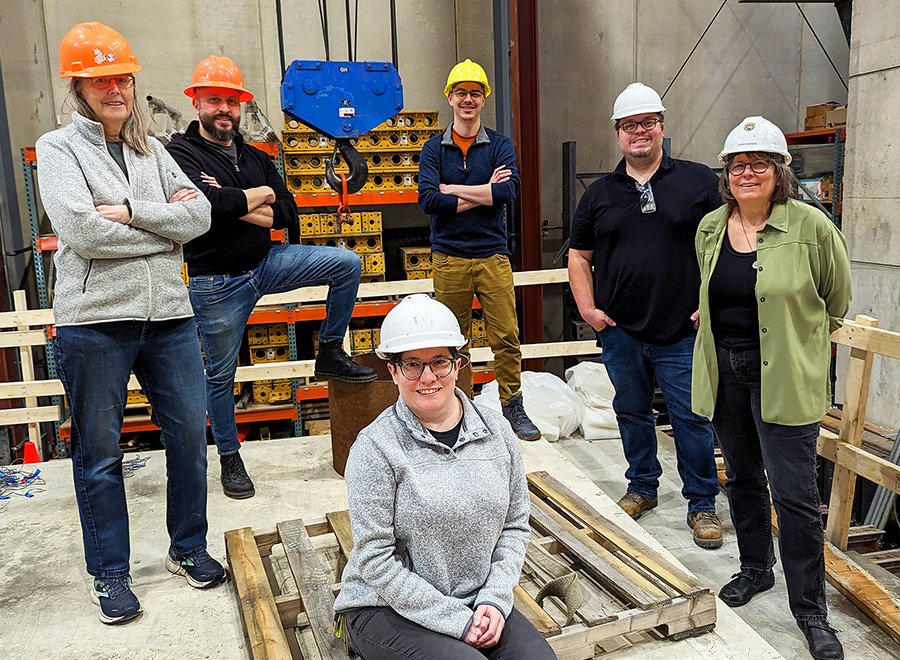
Front: Labs Director Lauren Linderman
Back row (left to right): First MAST Director Carol Shield, structures faculty Pedram Mortazavi and Ben Worsfold, Lab Manager and Research Associate Steve Barbachyn, and previous Lab Director Catherine French.