Warren Distinguished Lecture Series
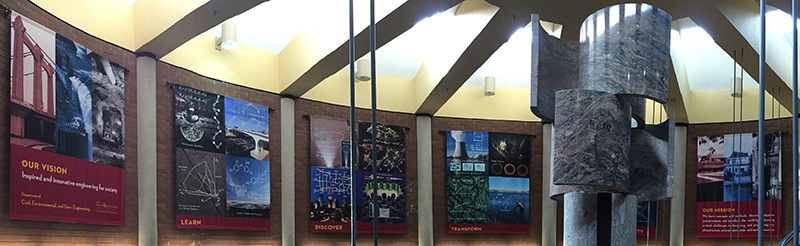
The Warren Distinguished Lecture Series is made possible through a generous, renewing gift from Alice Warren Gaarden. CEGE is continually thankful for her generosity, which allows us to bring in researchers and practitioners to share their knowledge with students, faculty, and friends of CEGE. A lecture is held most Fridays (September to May) at 10:10 a.m. in the George J. Schroepfer Conference Theatre (room 210) in the Civil Engineering Building.
If you cannot join us in person, please join us online. Register and join.
Find our archive on YouTube @umnCEGE
Fall 2026 Overview
September
11 Sebastian Behrens, University of Minnesota - Environmental
18 Ardeshir Ebtehaj, University of Minnesota - Environmental
25 Boya Xiong, University of Minnesota - Environmental
October
2 3-min Thesis, Graduate Students, University of Minnesota Sebastian – all areas
9 Dexter Lecture: Ronald D. Ziemian, Civil Engineering, Bucknell University - Structures
16 Xubin Zeng, Hydrology and Atmospheric Sciences, University of Arizona - Water Resources
23 Na Wei, Civil and Environmental Engineering, University of Illinois Urbana-Champaign - Environmental
30 Brian Park, Civil and Environmental Engineering, University of Virginia - Transportation
November
6 Heidi Nepf, Civil and Environmental Engineering, Massachusetts Institute of Technology - Water Resources
13 Jiaqi Ma, UCLA Samueli School of Engineering, University of California Los Angeles - Transportation
20 Sheng Dai, Civil and Environmental Engineering, Georgia Institute of Technology - Geomechanics
27 No Lecture — Thanksgiving Holiday
December
4 Assad Oberai, Aerospace and Mechanical Engineering, University of Southern California - Structures
11 Sehlin Lecture: Troy S. Magney, Forestry and Conservation, University of Montana
Upcoming Events
Cooperative Driving in Mixed Traffic: Connecting Human Drivers, Automated Vehicles, and AI
Friday, Oct. 30, 2026, 10:10 a.m.
210 Civil Engineering Building at the University of Minnesota
or
Online (registration is required; information will be sent to your email)
A Warren Distinguished Lecture with
B. Brian Park
Civil & Environmental Engineering and
Systems & Information Engineering
University of Virginia
Cooperative platooning is a promising technology for connected and automated vehicles, but its benefits are often limited in mixed traffic where human-driven vehicles disrupt vehicle-to-vehicle cooperation. This presentation highlights three complementary approaches for improving safety, mobility, and energy efficiency during the early stages of connected vehicle deployment.
Past Events
Harnessing Synthetic Biology to Turn Waste to Value
Friday, Oct. 23, 2026, 10:10 a.m.
210 Civil Engineering Building at the University of Minnesota
or
Online (registration is required; information will be sent to your email)
A Warren Distinguished Lecture with
Na Wei
Civil and Environmental Engineering
University of Illinois Urbana-Champaign
The growing challenges of environmental contamination and natural resource scarcity call for innovative solutions to ensure a sustainable future. The potential of synthetic biology is gaining increasing attention. Na Wei discusses her recent research work in leveraging synthetic biology to address waste-to-value challenges. Examples include i) engineering microbial cells and discovering enzymes for plastic degradation and upcycling, and ii) engineering functionalized biomaterials for recovering rare earth elements from waste streams. Underlying these research studies is the combined use of synthetic and molecular biology techniques, bioprocess and environmental engineering principles, and AI-driven approaches to solve emerging environmental challenges.
Observing and Understanding Snowpack and the Water Cycle over the Conterminous United States
Friday, Oct. 16, 2026, 10:10 a.m.
210 Civil Engineering Building at the University of Minnesota
or
Online (registration is required; information will be sent to your email)
A Warren Distinguished Lecture with
Xubin Zeng
Hydrology and Atmospheric Sciences
University of Arizona
Snowpack includes snow mass, depth, and coverage. It affects weather, climate, and water prediction. It is also important for our culture and economy. In this lecture, Zeng overviews some of his group's relevant work.
Over 100 Years of Design by Advanced Analysis
Friday, Oct. 9, 2026, 10:10 a.m.
210 Civil Engineering Building at the University of Minnesota
or
Online (registration is required; information will be sent to your email)
A Warren Distinguished Lecture
and Dexter Memorial Lecture
with Ron Ziemian
Civil Engineering
Bucknell University
In this talk, Ron Ziemian follows John Baker's work to establish plastic design in the UK, its arrival in the United States through the US Navy and Lehigh University, and Lynn Beedle's work to bring it into mainstream steel design.
Three-Minute Thesis Competition
Friday, Oct. 2, 2026, 10:10 a.m.
210 Civil Engineering Building at the University of Minnesota
or
Online (registration is required; information will be sent to your email)
CEGE Graduate Students
Civil, Environmental, and Geo- Engineering
University of Minnesota
Five CEGE graduate students compete to deliver their research thesis in just three minutes!
3MT develops academic, presentation, and research communication skills and supports the development of research students' capacity to quickly explain their research in a language appropriate to a non-specialist audience leaving them wanting to know more. The winner of this contest will go on to compete in the college-level 3MT Competition.
Beyond the Bulk: Mechanistic Insights into Nanoplastic Release and the Environmental Fate of Polymers
Friday, Sept. 25, 2026, 10:10 a.m.
210 Civil Engineering Building at the University of Minnesota
or
Online (registration is required; information will be sent to your email)
A Warren Distinguished Lecture with
Boya Xiong
Civil, Environmental, and Geo- Engineering
University of Minnesota
With global plastic production projected to triple by mid-century, understanding the environmental fate of plastics is paramount. While bulk plastics are visibly persistent, their environmental degradation generates a complex spectrum of highly mobile products, including micro- and nanoplastics (MP/NPs), dissolved carbon, and CO2. Nanoplastics readily infiltrate biological tissues and yet remain notoriously difficult to quantify and characterize. Foundational estimations are essential for conducting robust risk and life cycle assessments, ultimately informing science-based policymaking on how we should produce, use, and discard plastics.
Advancing Cold Region Monitoring through Microwave Remote Sensing and Physics-Informed Machine Learning
Friday, Sept. 18, 2026, 10:10 a.m.
210 Civil Engineering Building at the University of Minnesota
or
Online (registration is required; information will be sent to your email)
A Warren Distinguished Lecture with
Ardeshir Ebtehaj
Civil, Environmental, and Geo- Engineering
University of Minnesota
In this presentation, Ardeshir Ebtehaj highlights recent research advances in estimating soil moisture, land surface freeze–thaw states, snow water equivalent, and lake ice phenology using spaceborne L-band microwave radiometry from NASA’s Soil Moisture Active Passive (SMAP) mission.
Microbial interactions with anthropogenic pyrogenic carbon in soils and wastewater
Friday, Sept. 11, 2026, 10:10 a.m.
A Warren Distinguished Lecture with
Sebastian Behrens
Civil, Environmental, and Geo- Engineering
University of Minnesota
Behrens highlights his research on biochar–microbe interactions in soil and water and how they can impact microbial nutrient cycling and contaminant degradation processes. He presents data on how biochar and microbial processes impact each other and how this can help us to better understand biochar’s role in managing soil quality and soil/water remediation efforts. Finally, he discusses the need to develop guidelines on selecting and producing biochar formulations to meet specific soil and environmental constraints.
Data-friendly mesoscopic network modeling: learning, prediction, and decision making
Friday, May 1, 2026, 11 a.m.
A Warren Distinguished Lecture with
Sean Qian
Civil and Environmental Engineering
Carnegie Mellon University
With the availability of various data sources across all modes of transportation systems, it remains a challenge how to take advantage of those diverse spatio-temporal data to best understand travel patterns. In a mesoscopic network modeling framework, Qian formulates and solves for spatio-temporal passenger and vehicular flows in a multi-modal network explicitly considering solo-driving, bus, metro, parking, curb use and ride-sharing. The mesoscopic modeling approach can also be applied to real-time traffic operations, particularly early anomaly detection and proactive traffic management.
Learning from Sand: How natural extremes inspire adaptive geomaterial models
Friday, April 24, 2026, 10:10 a.m.
A Warren Distinguished Lecture with
Giuseppe Buscarnera
Civil Engineering
Northwestern University
Sand is the most ubiquitous class of natural granular solids and is an essential template to study this broad class of materials with unique features that render it adaptive to changes in pressure and density. It will be shown that suitable state variables can be introduced to explain and simulate the adaptivity of sand to external stress, thus opening new avenues for underground characterization, exploration of remote sites, infrastructure installation, and the design of new materials.
On Robust Shell Element and Nonlocal Approaches to Modeling Architected Structures and Fracture in Solids
Friday, April 17, 2026, 10:10 a.m.
A Warren Distinguished Lecture with
J. N. Reddy
Mechanical Engineering
Texas A&M University
This J.S. Braun/Braun Intertec Visiting Professor Lecture consists of Reddy’s recent research on (1) shell finite element with thickness stretches and free of all types of locking and (2) nonlocal approaches for modeling architected materials and structures and fracture in brittle and quasi-brittle solids including concrete and glass.